
We help you plan your future
If you are thinking about studying Vocational Education and Training (VET) or have questions about enrollment, degrees, or learning pathways, you will find all the information you need here.
You can also contact us or attend the open days at our centers.

Enrollment process
Explanation of the enrollment process for the 2026-2027 academic year.

Admission to VET
Requirements for admission to VET.
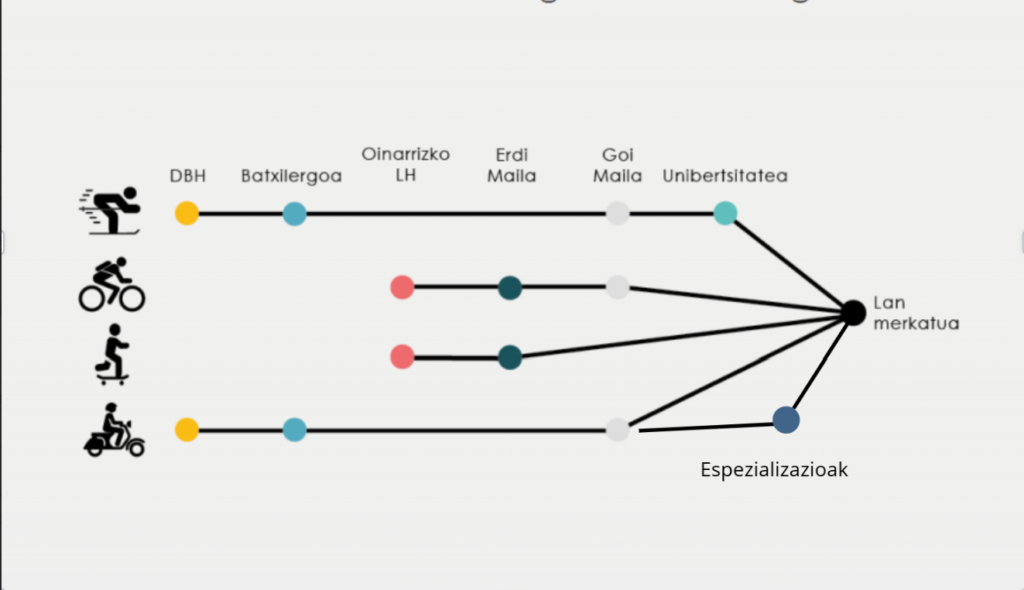
Learning pathways
Learn firsthand from current students and graduates about different educational pathways that will help you find the best direction for your professional future.

New VET: Relationship between degrees
Explanation of the relationship between the new Vocational Education and Training qualifications.

VET + University pathway
Requirements to access university after completing a Vocational Education and Training degree.

VET Levels
Explanation of the different levels available within Vocational Education and Training.
FAQ - Frequently Asked Questions
Admission applications (pre-enrollment): From May 4 to May 22
Provisional lists of admitted applicants: July 6
Regular enrollment: PHASE I: July 13-15, PHASE II: July 17, and PHASE III: July 21-22
Late enrollment: July 23 and 24, and from September 2 to October 17
- More information
Basic VET or Initial VET (Grade D): This is basic vocational training designed for students who are not achieving the expected success in secondary education. It lasts two years (three years in exceptional cases) and, in the Basque Country, allows students to obtain their ESO (Compulsory Secondary Education) diploma as well as direct access to Intermediate VET.
Intermediate VET (Grade D): This is a parallel pathway to the Baccalaureate (Bachillerato). In two years, students earn a Technician degree, which grants direct access to Higher VET and certain specialization courses. This training is closely linked to companies, resulting in a high employment rate.
Higher VET (Grade D): This is a higher education stage that trains qualified Advanced Technicians. Most students enter after completing their Baccalaureate, though it can also be accessed after an Intermediate VET degree. It lasts two years, and the final grade point average can be used to enter university or to continue training through another Higher VET cycle or specialization course. This training is closely linked to companies, resulting in a high employment rate.
Dual VET: All VET students acquire part of their knowledge within a company through internships during both their first and second years. Depending on the number of hours spent at the company, it is classified as either General Dual or Intensive Dual. https://www.fpeuskadiduala.eus/
Training for Employment (Grades A, B, C): This training is aimed at both employed and unemployed individuals, allowing them to acquire qualifications or even earn a Basic, Intermediate, or Higher VET degree by completing several Grade C courses or professional certificates. http://www.lanbide.euskadi.eus/formacion-lanbide/-/informacion/que-son-los-certificados-de-profesionalidad/
Distance learning VET: Some training cycles can be studied online through BIRT LH (the Basque Government’s Distance VET Center). You can check the available programs here: https://www.birt.eus/eu/
If you want information about the admission requirements for Vocational Education and Training, you can click here: http://www.euskadi.eus/informacion/requisitos-de-acceso-a-formacion-profesional//web01-a2hlanhz/es/
Vocational training is organized into training cycles or Grade D programs at basic, intermediate, or higher levels. The cycles are grouped into professional families and last 2,000 hours (equivalent to 2 academic years). In all cases, a portion of these hours is dedicated to learning at the educational center, and another portion is spent training within a company.
Successfully completing a basic or initial VET cycle awards the title of Basic Professional; completing an intermediate VET cycle awards the title of Technician; and completing a higher VET cycle awards the title of Advanced Technician.
Thanks to HETEL’s Erasmus+ program, students from basic, intermediate, and higher VET can complete part of their company training in a European country.
In this link, you can find information about the credits transferred when studying a university degree at UPV/EHU with a Higher VET qualification: https://gestion-alumnos.ehu.es/pls/entrada/accw3020.htm At Mondragon Unibertsitatea, you can find credit transfer information for each degree program here: https://www.mondragon.edu/es/grados-universitarios Please check the credit transfer policies at the specific university where you plan to pursue your studies.
At HETEL centers, you can study all levels of Vocational Training (Basic VET, Intermediate VET, and Higher VET) across more than 20 professional families. You can check the full list of programs here: Vocational Offer
Use of active methodologies: ETHAZI is a methodology that allows students to learn through project-based and collaborative work.
Promoting entrepreneurship: Through projects like Urrats bat, Ikasenpresa, and others, VET students at HETEL centers actively develop their entrepreneurial skills.
Innovation projects for companies: Centers work on real-world projects for businesses with the direct participation and involvement of students, providing training that is highly aligned with the labor market.
High employability rate: Check out the [HETEL employability report].
Did you know that after completing a training cycle in Mechanical Manufacturing Production Scheduling, Mechanical Manufacturing Design, Metallic Constructions, Industrial Mechatronics, Industrial Automation and Robotics, Electrotechnical and Automated Systems, or Electronic Maintenance, you can enroll in the Mechatronics Engineering Degree and graduate in just 3 years? Furthermore, you will study in a dual format, combining classes with a company placement. (Available in both Bilbao and Arrasate).
Did you know that after completing any higher VET cycle within the professional families of Informatics and Communications, Electricity and Electronics, Mechanical Manufacturing, or Installation and Maintenance, you can enroll in the Robotics Engineering Degree and graduate in just 3 years? Furthermore, you will study in a dual format, combining classes with a company placement.
You can also pursue other Engineering Degrees, with recognition of between 30 and 40 credits when transitioning from related Higher VET cycles (CFGS).